VOICE and The Book of Five Rings - Collaboration
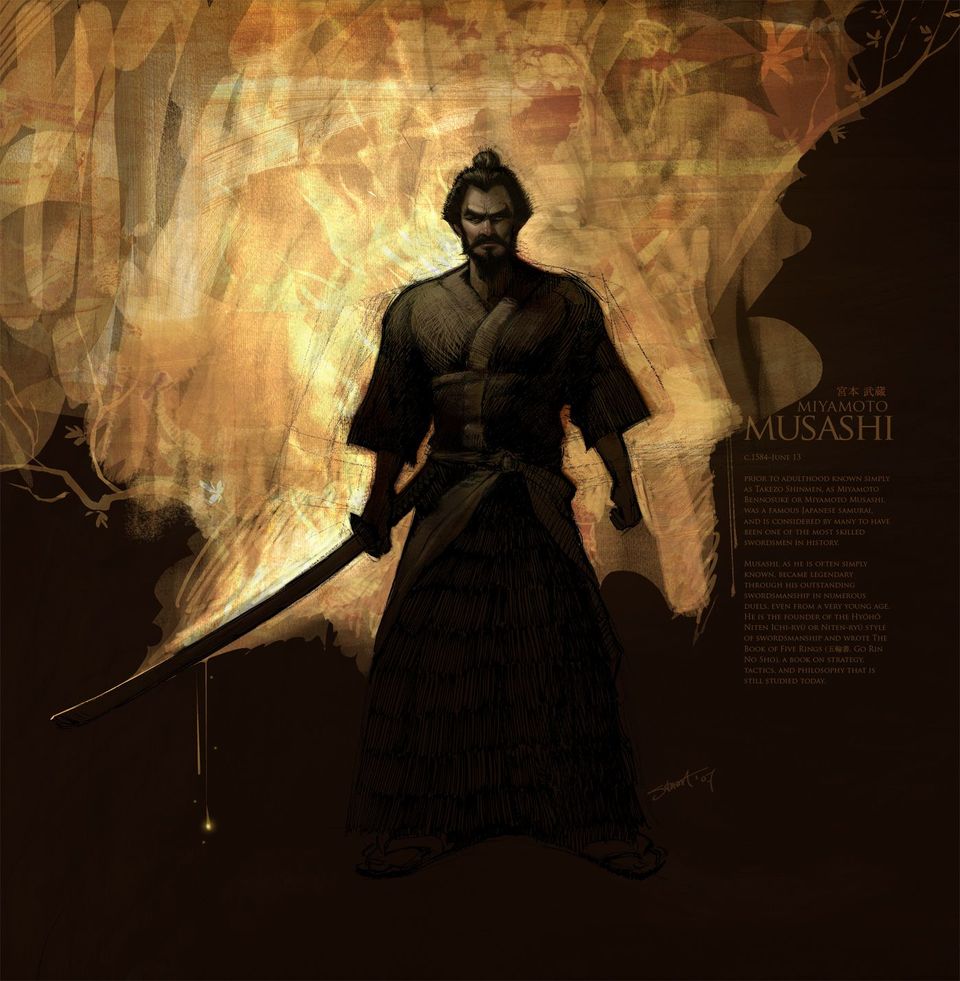
This is the fourth post in a series on the VOICE principles and the philosophy of Miyamoto Musashi as written in The Book of Five Rings. The translation of The Book of Five Rings used here was sourced from WikiQuote.
I wrote this series while working at YP.com. I’ve updated some of the language to reflect the past tense and generally make it read easier.
You can start from the beginning of the series here.
At YP.com we practiced the VOICE principles (Velocity, Ownership, Innovation, Collaboration, and Execution), striving to embody each of them in order to become more effective at not only our jobs, but in our personal lives.
In the 16th century, a Japanese Ronin (a lord-less samurai) named Miyamoto Musashi wrote The Book of Five Rings. In it Musashi describes his philosophy, called “The Way” of sword fighting. His philosophy is still studied today and can be applied across any discipline.
This series explains how the sword fighting principles of The Way can be generalized to each VOICE principle, leading you to becoming more productive in your life. In the previous entry, I wrote about how Musashi’s teachings relate to Innovation. In today’s post, I’ll be covering Collaboration.
Collaboration
Given that Musashi was a Ronin who touted independence, you might not expect him to have much to say on the topic of collaboration. But despite his steadfast belief in independence, Musashi believed in strategies incorporating larger groups of people, and the complimentary effect of working together to achieve a common goal.
Collaboration is something that all organizations live for. The entire purpose of an organization of people, regardless of type, is to achieve larger goals through the collective labor of people. It’s the efficient and effective coordination of those people resources that organizations have struggled with since societies began. One measure of organizational maturity is the volume and ease of which collaboration occurs across hierarchical boundaries. People being people, however, make collaboration complicated.
In large-scale strategy you can frighten the enemy not by what you present to their eyes, but by shouting, making a small force seem large, or by threatening them from the flank without warning. These things all frighten. You can win by making best use of the enemy's frightened rhythm.
Collaboration is a multiplier of resources. With efficient collaboration, paired with effective leadership, small teams can achieve bigger goals than a larger competitor.
Take tech startups, as an easy example. A small team has an idea, and through laser focus, dedication, and teamwork, they build a product in six months that their 100x competitor couldn’t build in 18 months. The startup can outmaneuver and effectively harass their enemy, causing enough panic and harm for their competitor to give up market share or, worse, eventually be displaced and fail outright in the business.
By utilizing their advantages as a small, collaborative team, they can build swiftly, pivot often, and create exceptional experiences for their customers. Without that efficient and effective collaboration, any team, large or small, will inevitably lose to a competitor. It’s important to not only seek collaboration to simply survive in a competitive environment, but to thrive.
In large-scale strategy, it is beneficial to strike at the corners of the enemy's force, If the corners are overthrown, the spirit of the whole body will be overthrown.
Effective coordination in business requires collaboration across every specialty. If any part of the business is weak, you can be confident that that area will be attacked by your competitors. This means an organization must be brutally honest with themselves about their own weaknesses, and address them collectively. If the marketing is bad, the sales and product teams need to step up to support the marketing team in a pivot to better marketing. If the product is unreliable, the sales and customer service teams need to cover for the engineering and operations teams to ensure the problems are identified and fixed.
On the opposite side, a highly cooperative team can tackle enormous problems by chipping away at the corners of a gargantuan issue. How do you eat an elephant? One bite at a time. But when you’re in an optimized team, you’re planning the most efficient method for eating the entire elephant, eating in shifts, varying your bite size based on the part you’re eating, and so on. I stretched that metaphor a little far; please don’t eat an elephant, people. The point is that the goal of every leader should be to utilize the strengths of every individual on the team and coordinate and cooperate to harness those strengths to achieve the maximum impact.
The "mountain-sea" spirit means that it is bad to repeat the same thing several times when fighting the enemy. There may be no help but to do something twice, but do not try it a third time. If you once make an attack and fail, there is little chance of success if you use the same approach again.
Have you ever been in a meeting where you’re talking about the lack of progress you’re making and someone says you just need to keep doing it, do more of it, or do it again? We’ve probably all been there, and we’ve likely been that person saying that at some point in our lives too. The thing is, sticking with a strategy or tactic isn’t necessarily wrong, unless it is.
Just as it’s easy to fall into this trap individually, it can be even worse when you repeat your tactics as a group. It might be tempting to just do the same thing again that you’re familiar with, especially when the group is already familiar with it, but you should avoid doing exactly the same thing twice. Is every M&A deal similar? Sure, fundamentally all the same principles apply, but first principles are repeatable. The methods you use to execute on those principles should vary from deal to deal.
Most importantly, Musashi states what should be obvious to everyone, but is still important to repeat. If your teams’ strategy failed the first time it was implemented, there’s very little chance it will work if tried again. If you weren’t successful in changing your tactics to adapt to the situation the first time, what makes you think you’ll be successful now? Perhaps you’ve identified some issues in your postmortem that you didn’t reveal during the execution, but it’s almost always a mistake to think “we just didn’t execute it properly last time”. That’s your ego talking. Start over and try again.
Conclusion
Without collaboration, we’re doomed to fail. Without effective and efficient collaboration, we’re doomed to lose. And without an effectively collaborative strategy, we can’t win. Musashi’s Way encompasses both individual thinking, as well as large scale strategy, and by considering his philosophy we can apply his teachings to our everyday work.
Becoming collaborative isn’t a switch to turn on. It requires subjugating your ego, demonstrating and expecting transparency, and seeking understanding, cooperation, and mutual accomplishment over individual gain. And like every skill, it weakens without practice and ongoing cultivation.
Next in the series we’ll read what Miyamoto Musashi writes about Execution.